
It’s 3 a.m., and you’re on the couch with a bottle or a baby latched on. You look at the monitor and do the math again. Your baby is five months old, eats well all day, and still wakes up hungry at night. So you start to wonder: when do babies stop night feeds, and is your baby running late?
Short answer: there’s a wide normal range. Plenty of babies can go most of the night without a feed somewhere between 4 and 9 months, but many breastfed babies keep one night feed past their first birthday, and that’s fine too. Readiness matters more than age, and you can cut night feeds gently without a week of crying. If you dream feed, our complete guide to dream feeding explains how that feed fits in.
When Do Babies Stop Night Feeds? What Age Usually Looks Like
Newborns need to eat around the clock. Their stomachs are tiny, so they wake every two to three hours, day and night. That’s biology, not a sleep problem.
Things shift around 4 to 6 months. By then most babies take in more milk during the day and can stretch longer at night. The American Academy of Pediatrics notes that by about 6 months, many babies can sleep through the night without a feed. You can read their overview in Getting Your Baby to Sleep on HealthyChildren.org.
“Can” is the key word, though. Some babies stop night feeds on their own at 3 months. Others still need one at 10 months, especially breastfed babies, babies born early, or babies who had a slow start with weight gain. Your baby’s growth curve tells you more than the calendar does.
Keep in mind that “sleeping through the night” for a baby often means a stretch of six to eight hours, not a full twelve. A baby who sleeps from 7 p.m. to 3 a.m. and then eats once is already doing what many pediatricians would call sleeping through.
Hunger or Habit? Signs Your Baby Is Ready to Drop Night Feeds
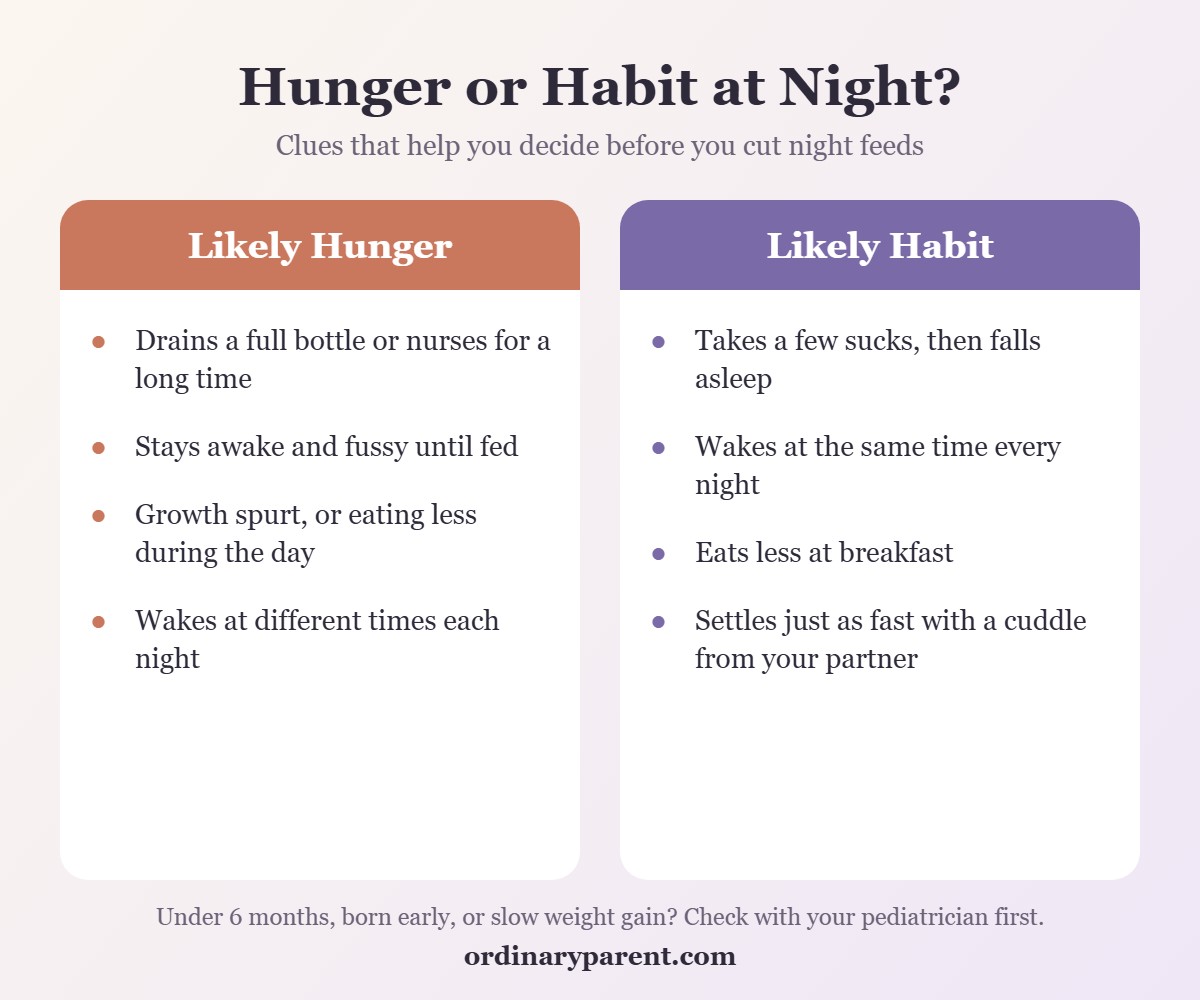
The tricky part is telling real hunger from a habit. Babies learn to expect food at certain times. If they get a full meal at 2 a.m. every night, their body starts to wake up for it.
A few clues point toward habit. Your baby takes a few sucks and falls back asleep. They wake at almost the exact same time every night. They eat less at breakfast because they filled up overnight. Or they settle just as fast when your partner rocks them instead of feeding them.
Real hunger looks different. Your baby drains a full bottle or nurses for a long time. They stay awake and fussy until they eat. They’re going through a growth spurt, or they’re sick and eating less during the day.
Readiness also depends on the basics. Your doctor should be happy with your baby’s weight. Your baby should be eating solid foods or taking good daytime feeds. If those things are in place and you see the habit clues, your baby may be ready to start night weaning.
How to Stop Night Feeds Gently
You don’t have to go cold turkey. A slow taper gives your baby’s body time to move those calories into the daytime, and it’s usually easier on everyone’s sleep.
For bottle-fed babies, cut the night bottle by about 1 ounce every two or three nights. When you get down to 1 or 2 ounces, you can skip it and soothe your baby back to sleep instead. Our guide on how much milk to offer at a dream feed gives you a sense of normal amounts by age.
For breastfed babies, shorten the feed by two to five minutes every couple of nights. Once you’re at about five minutes, try other comfort like patting, shushing, or a cuddle in the dark. Some parents also stretch the time between feeds, so a baby who woke at 1 a.m. and 4 a.m. moves to one feed at 3 a.m.
It also helps to have the non-feeding parent handle wake-ups for a few nights. A baby who smells milk tends to want milk. And offer full, calm feeds during the day so your baby doesn’t make up the gap at night.
The Dream Feed and Night Feeds: How They Fit Together
If you use a dream feed, you might wonder which one to drop first. Most parents keep the dream feed a little longer and work on the middle-of-the-night feeds first. The dream feed happens on your schedule, before you go to bed, so it tends to protect your own sleep.
Once the 2 a.m. feed is gone and your baby sleeps well for a couple of weeks, you can start tapering the dream feed too. We walk through that step in when to stop dream feeding your baby.
Sometimes the dream feed itself causes the early wake-up. If your baby eats at 10:30 p.m. and then wakes at 4 a.m. like clockwork, try moving the dream feed a bit earlier or dropping it for a few nights. Watch what happens before you change anything else.
Why Night Wakings Come Back After You Stop Night Feeds
You did the taper, you had a week of good sleep, and now your baby is up at 2 a.m. again. This happens to almost everyone, so don’t assume you’ve failed.
Common reasons include teething, a cold, a growth spurt, or a new skill like rolling or crawling. Sleep regressions around 4 months and 8 to 10 months can also stir things up. Travel and daylight saving time can throw off the rhythm for a few nights.
During these patches, it’s okay to offer a feed if your baby truly seems hungry. One feed during a rough week won’t undo your progress. Go back to your plan once your baby feels better. If your baby wakes every hour, though, hunger usually isn’t the whole story. Our post on why your baby is waking up every hour covers other causes worth checking.
When to Talk to Your Pediatrician
Night weaning is a normal step, but some babies aren’t ready for it yet. Talk to your pediatrician before you cut night feeds if your baby is under 6 months, was born premature, or has had trouble gaining weight.
Also call your doctor if your baby has fewer wet diapers than usual or seems unusually sleepy and hard to wake. The same goes for a baby who refuses feeds during the day or loses weight. If you’re breastfeeding and worried about your milk supply, a lactation consultant can help you plan a slower taper.
If something feels off, call the office. That’s what they’re there for.
Common Questions About Night Feeds
Is it normal for a 9-month-old to still wake up to eat?
Yes, especially for breastfed babies. Many 9-month-olds still have one night feed. If your baby is growing well and you’re both coping, there’s no rush to stop.
Should I stop night feeds and start sleep training at the same time?
Many parents find it easier to do one thing at a time. Wean night feeds first, then work on how your baby falls asleep. Changing both at once can mean more tears for everyone.
Do solid foods help babies sleep longer?
Not on their own. The AAP advises against adding cereal to a bottle, and it isn’t a reliable way to get longer sleep. Solids add calories during the day, which can help as you wean, but don’t start them before your doctor says your baby is ready.
How long does night weaning take?
A gradual taper often takes one to two weeks. Some babies adjust in a few nights, while others need a little longer.
Gentle Nights Ahead
Babies stop night feeds on their own timelines, and you don’t need to hit a magic date. Watch your baby, keep your doctor in the loop, and take it slow. If the late-evening feed is the last one standing, read our guide on when to stop dream feeding to plan your next step.

Ordinary Parent is a parenting blog dedicated to sharing practical advice, real-life experiences, and helpful tips for modern moms and dads. The goal of this platform is to make everyday parenting easier by providing simple solutions, organization strategies, and honest insights into family life.