
It’s 10:30 at night. The baby has been asleep for a few hours, you’re warming a bottle in the dark, and you’re wondering how full to make it. Two ounces? Six? If you’ve been asking yourself how much milk for a dream feed is “right,” you’re in good company. Most guides explain what a dream feed is and skip the part you actually need at the counter.
The short answer: a dream feed is usually a normal-sized feed for your baby’s age, or a little less. There’s no special dream feed number. You want enough milk to carry your baby through the longest stretch of the night. You don’t want so much that they spit up or start skipping daytime feeds.
If you’re new to the idea, our guide on what a dream feed is covers the basics. This post is about the bottle itself. For the feeding technique, see how to dream feed without waking your baby.
How much milk for a dream feed: start with what your baby already drinks
Your baby already tells you how much they need. Look at the last few days of feeds. If they usually finish 4 ounces at each bottle, a 4-ounce dream feed is a sensible starting point. If they’re breastfed, offer the breast as you normally would, or one side if they tend to drift off fast.
This works because the dream feed isn’t extra food. It’s one of the feeds your baby would take anyway, moved to a time that suits you. You’re shifting a feed from 1 a.m. to 10:30 p.m., not adding a bonus meal. If you’re still choosing that time, our dream feed schedule for newborns shows where it usually fits.
Watch the first few nights closely. A baby who takes the whole bottle and sleeps longer is getting the right amount. A baby who drinks half and pushes the nipple away has had enough, even if half seems small.
How much milk for a dream feed by age
The American Academy of Pediatrics gives some useful averages for formula. Babies take about 2.5 ounces of formula a day for every pound of body weight. Most babies don’t need more than 32 ounces in 24 hours. You can read the full breakdown on HealthyChildren.org.
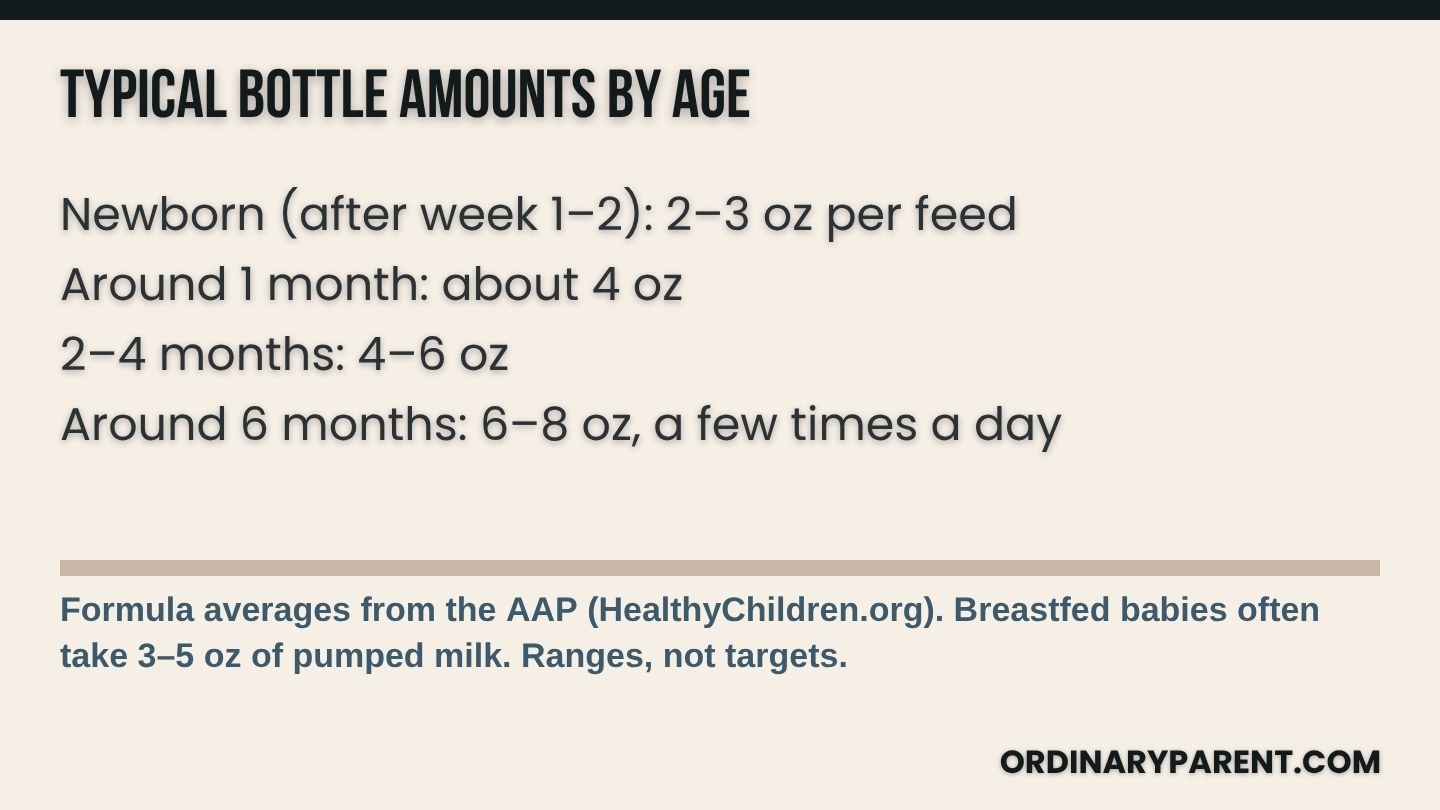
For a typical baby, that looks something like this. Newborns take 2 to 3 ounces per feed after the first week or two. By one month, many babies drink around 4 ounces. Between two and four months, 4 to 6 ounces is common. By six months, many babies take 6 to 8 ounces a few times a day.
Breastfed babies are a little different. Their daily intake tends to stay fairly steady between one and six months, so bottles of pumped milk often stay in the 3 to 5 ounce range. Don’t be surprised if a breastfed baby takes less from a bottle than a formula-fed friend of the same age.
Treat all of these as ranges, not targets. Your baby’s weight, growth and appetite matter more than any chart.
Should a dream feed be smaller than a daytime feed?
Sometimes, yes. A sleepy baby often drinks less than an alert one. They suck slower, pause more and drift off before the bottle is empty. That’s fine. You don’t need to wake them up to finish.
Some parents also offer a slightly smaller dream feed on purpose. A very full tummy plus lying flat can mean more spit-up for babies who tend toward reflux. Starting an ounce below the usual amount can help. You can always add more next time if your baby still wakes early.
On the other hand, if your baby drains the bottle and wakes an hour later, try a little more. Go up by half an ounce to an ounce at a time and give each change two or three nights before judging it.
Breast milk or formula for the dream feed?
Either works. Use whatever your baby normally drinks. Some parents offer formula at the dream feed because they’ve heard it keeps babies fuller. That idea isn’t well supported, and switching milk only for this feed can upset a sensitive tummy.
If you’re breastfeeding, nursing during the dream feed has a bonus. It removes milk from your breasts before the long night stretch, which can help you stay comfortable. If your partner gives a bottle instead, you may still need to pump at some point to protect your supply.
Whatever milk you use, keep the setup calm. Low light, no talking and a quick, gentle burp if your baby needs one. Our post on burping after a dream feed covers that part in detail.
Signs you’ve found how much milk your baby needs at the dream feed
You’ll know the amount is working when the pattern settles. Your baby sleeps a longer first stretch than before. They still eat well in the morning. They aren’t spitting up much more than usual. And they keep growing well at checkups.
Signs the amount needs a tweak are just as clear. Waking soon after the feed can mean too little. Lots of spit-up, gassy squirming or a baby who refuses the morning bottle can mean too much. Neither is a crisis. Just nudge the amount and watch again.
Remember that some babies don’t respond to a dream feed at all. If you’ve tried for a week and nothing has changed, that’s useful information too. Our article on whether dream feeding works explains why.
When to talk to your pediatrician
Call your baby’s doctor if your baby isn’t gaining weight as expected, has fewer wet diapers than usual, or seems hungry all the time no matter how much they drink. Forceful or frequent vomiting, blood in spit-up or stools, or a baby who struggles to breathe while feeding also needs a prompt check.
It’s also worth asking before you change amounts if your baby was born early, has reflux, or has any medical condition. Your pediatrician can give you a number that fits your own baby.
Common questions about night bottles
Can I give too much milk at a dream feed?
Yes, it’s possible. A baby who is overfed may spit up a lot, seem gassy or uncomfortable, or eat less the next morning. Follow your baby’s cues and stop when they lose interest.
Should I wake my baby fully to finish the bottle?
No. The point of a dream feed is to keep your baby drowsy. If they stop sucking and drift off, the feed is done.
Does the amount change as my baby grows?
It usually follows their daytime feeds. As their regular bottles get bigger, the dream feed can grow with them. Once solids are well established, many babies need it less and less.
What if my baby refuses the bottle at night?
Some babies simply aren’t hungry at that hour. Try again a little later, or skip it for a few nights. If they keep refusing, they may not need a dream feed at all.
Start with your baby’s usual amount tonight. Working out how much milk for a dream feed suits your baby takes a few nights of watching and small changes. When you’re ready to think about the bigger picture, our guide to when to stop dream feeding is a good next read.

Ordinary Parent is a parenting blog dedicated to sharing practical advice, real-life experiences, and helpful tips for modern moms and dads. The goal of this platform is to make everyday parenting easier by providing simple solutions, organization strategies, and honest insights into family life.