
There’s a specific kind of silence that happens right after you click the car seat buckle. Your baby looks up at you, totally calm, maybe even a little curious. Then you close the door, walk around to the driver’s side, start the engine, and by the time you’ve put the car in reverse, it’s over. Full-volume crying. Red face. The kind of wail that makes the guy in the next lane glance over at you at the light.
If that’s how most of your drives go lately, you’ve probably asked yourself why does my baby hate car rides so much when every other baby on Instagram seems to pass out the second the engine turns on. Honestly, those babies exist, but they’re not the majority. Plenty of infants find the car seat confusing, uncomfortable, or just plain boring, and they let you know about it the only way they can.
The useful thing is that the crying usually has a cause, and once you figure out which one fits your baby, you can actually do something about it.
It’s usually not the car. It’s what the car takes away.
Think about what a car ride looks like from your baby’s side. A few minutes ago they were on your shoulder, smelling you, hearing your heartbeat. Now they’re strapped into a padded shell facing the back seat, and you’ve vanished. You’re still talking, sure, but your voice is coming from somewhere they can’t see. For a baby who spends most of the day being held, that’s a pretty big downgrade, and a lot of car seat crying is really just a baby asking where you went.
Then there’s the timing. Most of us drive when we have to, not when it suits the baby, so car rides end up happening right before a feed, right after a missed nap, or in that stretch of late afternoon when everybody in the house is fraying a little. A baby who is already hungry or overtired doesn’t need much of a push, and getting buckled in can be the thing that tips them over. The car takes the blame for a meltdown that was on its way regardless.
Temperature is the one parents tend to overlook. Car seats are snug and padded, cars warm up fast in direct sun, and babies often get dressed for the weather outside rather than the weather in the back seat. If you slide your hand behind their neck and it’s damp, they’re too warm, and that alone can make a baby cranky.
Some babies are also just wigglers. They want to kick, arch, and roll, and a five-point harness doesn’t allow any of that. If your little one also protests the stroller and the high chair, this is probably temperament more than anything you’re doing wrong. And occasionally, though it’s less common in young infants than in toddlers, motion sickness is part of it. Fussing that builds the longer the drive goes, unusual drooling, looking pale, or spitting up only in the car are the clues to watch for.
One more possibility worth naming. If your baby is somewhere in those first few months and cries hard for long stretches no matter where you are, the car might just be one more place it happens. Our breakdown of purple crying vs colic covers that stage in more detail, and it’s reassuring to know how normal it is.
Small changes that make a real difference
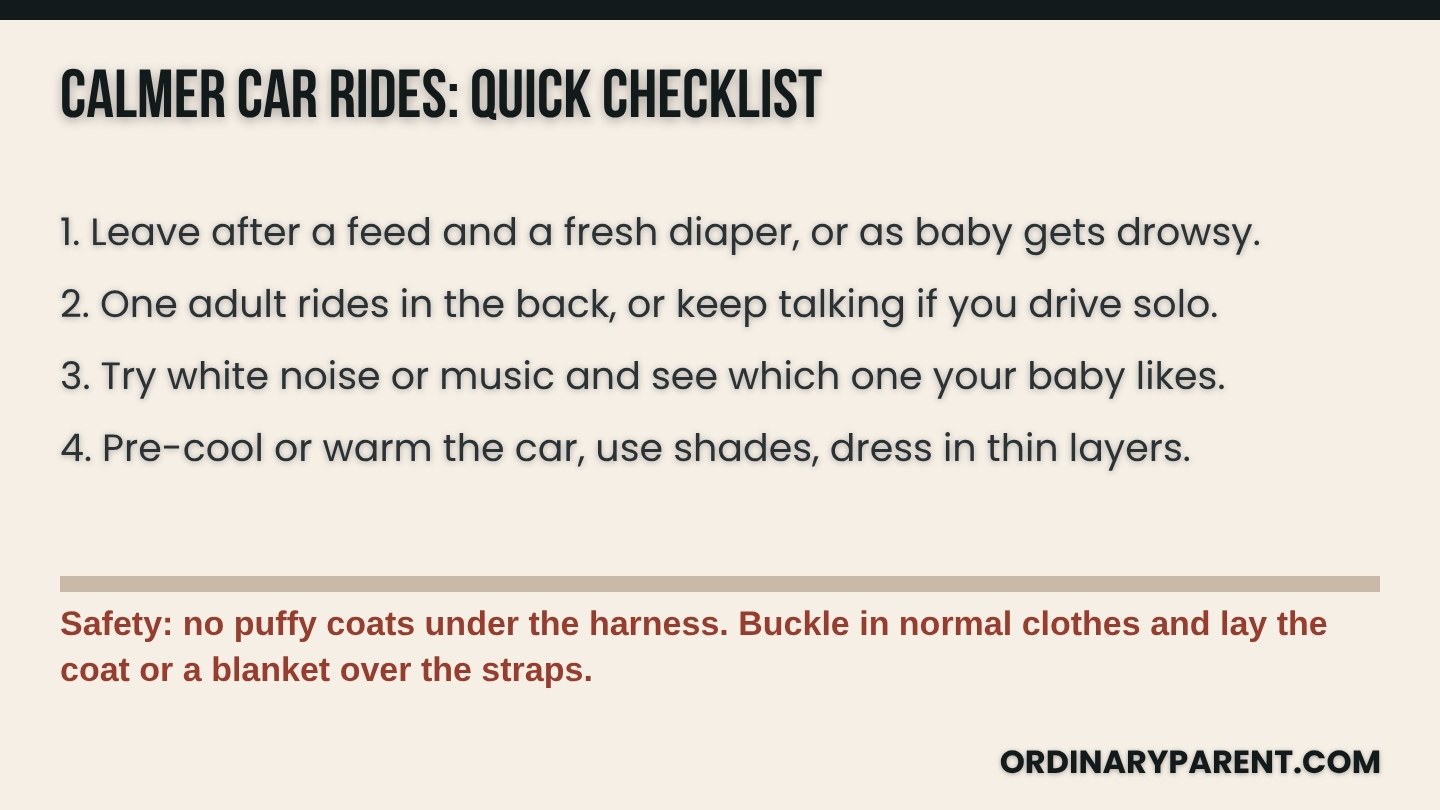
The single biggest fix for most families is moving drives to better moments. Leaving right after a feed and a fresh diaper changes a lot, and so does setting out just as your baby is getting drowsy, so the hum of the road finishes the job for you. If you’ve already worked out a rhythm around feeds, like the timing in our dream feed schedule for newborns, use it to plan when you run errands. A ten-minute trip at the right time beats a forty-minute one at the wrong time every single time.
When there are two adults in the car, it helps to have one of you ride in the back. A baby who can see a face, hold a finger, and hear someone close by is far less likely to panic. If you’re driving solo, keep talking to them anyway. Narrate the drive, sing badly, tell them about the grocery list. It sounds silly, but your voice is the most familiar thing in their world, and it carries more weight than you’d think.
White noise is worth trying too. A lot of babies calm down to a steady shushing sound, which is close to what they heard before they were born, and you can play it through the car speakers or from a small machine clipped somewhere safe. Some babies would rather have music. You’ll figure out pretty quickly which camp yours is in.
For temperature, cool or warm the car before the baby goes in, use window shades on the sunny side, and dress them in thin layers. Skip the puffy winter coat under the straps altogether. Bulky coats squash down in a crash and leave the harness too loose to do its job, so buckle them in normal clothes and lay a blanket or the coat over the top of the straps instead.
Check the seat before you blame the baby
It’s worth taking a few minutes to make sure the seat itself isn’t the problem. Straps that dig in, a buckle pressing into a thigh, or a recline angle that lets their head drop forward would make anyone miserable. In a rear-facing seat, the harness should come out of the slots at or just below your baby’s shoulders, and the chest clip should sit level with their armpits rather than down on their tummy. Once they’re buckled, try to pinch a fold of the strap at their collarbone. If you can grab some fabric, it needs to be a bit tighter.
If you’re unsure about any of it, a certified child passenger safety technician can check your installation, and many hospitals and fire stations offer that for free. While you’re at it, take out anything that didn’t come with the seat, like extra head pillows, strap covers, or plush inserts. They haven’t been crash-tested with your seat and can change how the harness fits. Soft toys that couldn’t hurt anyone if they went flying are fine for something to look at.
Car seat naps, and when to call the doctor
If your baby finally drifts off on the drive, enjoy it. Just move them to a flat, firm surface like their crib or bassinet once you’re home. The American Academy of Pediatrics advises against letting babies sleep in car seats outside the car, because the angle can make it harder for young infants to keep their airway open. Along the same lines, don’t feed your baby or prop a bottle while the car is moving. If they need to eat, pull over somewhere safe, take them out, feed them, and then get back on the road.
Most car seat crying is simply a baby who would rather be in your arms. Still, it’s worth a call to your pediatrician if your baby vomits regularly during or after drives, if the crying comes with a fever, unusual sleepiness, or trouble feeding, or if they seem to be in pain whenever they’re reclined, which can point to reflux. And if your gut tells you something is off, trust that. Nobody will mind you asking.
This phase really does pass
As babies grow, they get more curious about what’s out the window, their naps get more predictable, and the car gradually becomes just another place they spend time. Until that happens, plan around their routine, keep the back seat comfortable, and give yourself permission to pull over and take a breather when you need one. You aren’t doing anything wrong. Some babies just need a little longer to make peace with the car seat.

Ordinary Parent is a parenting blog dedicated to sharing practical advice, real-life experiences, and helpful tips for modern moms and dads. The goal of this platform is to make everyday parenting easier by providing simple solutions, organization strategies, and honest insights into family life.