
The baby is finally asleep on your chest. Their breath is warm on your neck, your coffee is cold on the side table, and you’re doing quiet math. How long can you stay here? Is this normal? Are you building a habit you’ll pay for later? If you’ve searched for contact naps by age, you want to know what’s expected. You also want to know when to nudge things along.
The short answer: wanting to nap on a parent is normal for a lot longer than most people expect. What changes with age is the reason behind it and how easy it is to shift. Below, we walk through each stage and the safety rules that never change. We’ll also cover the signs that a change would help.
Why babies want contact naps at all
For most of human history, babies slept close to an adult. Your warmth, smell, heartbeat and breathing tell a young baby they’re safe. That makes it easier for them to drift off and harder to stay asleep once you put them down. It’s not manipulation and it’s not a bad habit. It’s how a brand-new nervous system works.
Daytime sleep is also lighter and shorter than night sleep. A baby who wakes after 30 minutes in the crib may sleep for 90 minutes on you. Each time they surface between sleep cycles, you’re still there. That’s why so many parents end up with one “good” nap a day, and it’s the one on their chest.
Contact naps by age: newborn to 3 months
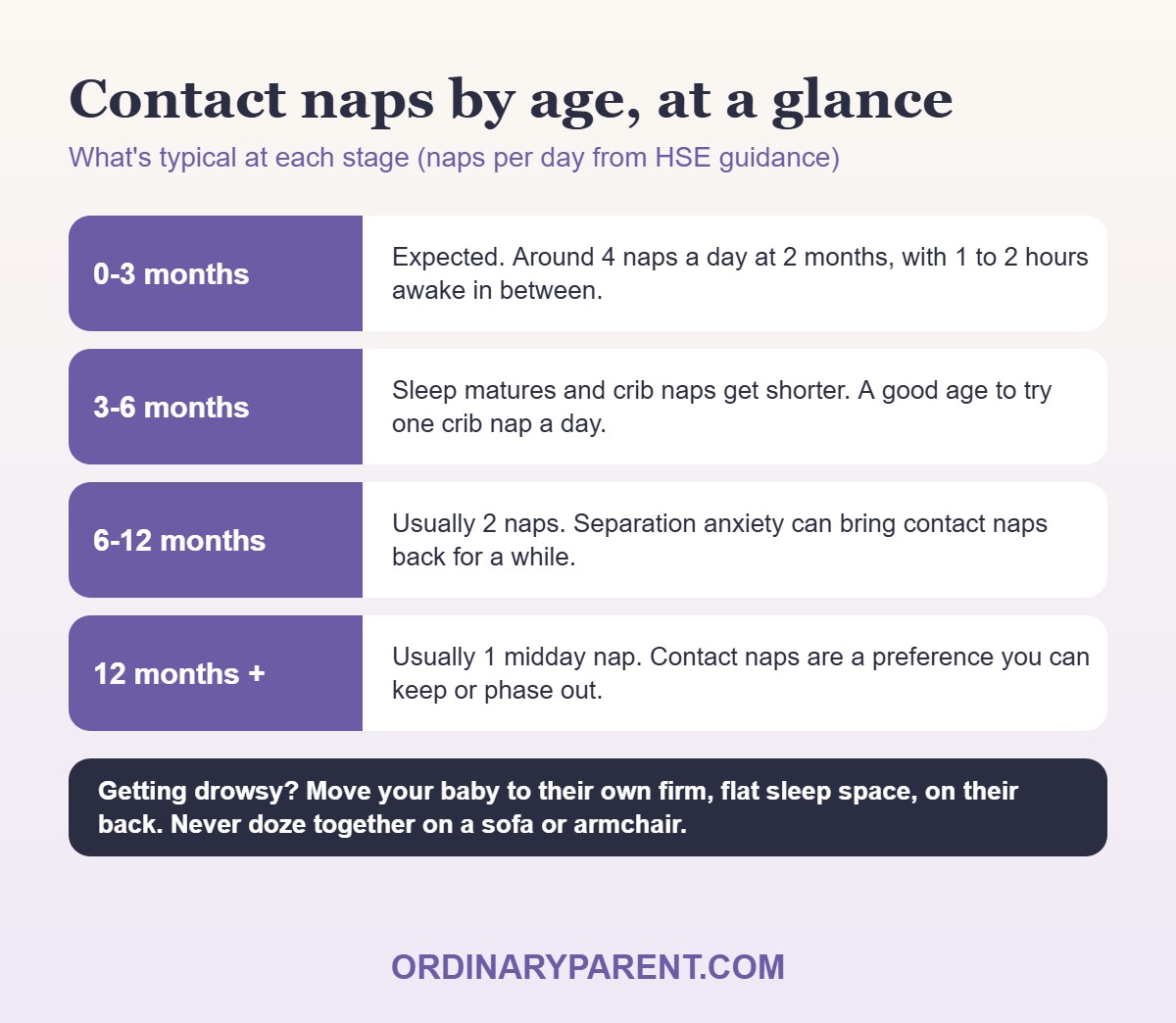
In the first three months, contact naps are about as normal as it gets. Newborns sleep a lot, but in short pieces, and they often won’t settle anywhere except in arms. The HSE in Ireland says a 2-month-old usually takes around four naps a day. There are only one to two hours of awake time between them. That’s a lot of naps to fight over, so don’t.
This is also the purple crying and colic window for many families. If your baby only calms on you in the late afternoon, read our guide to purple crying vs colic to tell the difference. At this age the goal is simple: rest when you can and follow the safety rules below. You can practise one crib nap a day if you want to, but there’s no deadline.
Contact naps by age: 3 to 6 months
Somewhere around three to four months, sleep matures. Babies start cycling through lighter and deeper sleep more like adults do. Many parents notice naps suddenly get shorter in the crib, while naps on a parent stay long. Your baby isn’t going backwards. They’ve just become more aware of the shift between cycles.
The HSE describes wake windows of roughly two to two and a half hours by this point. Getting the timing right matters more than where the nap happens. An overtired baby fights any sleep space, and an under-tired baby won’t fall asleep anywhere. If you’d like to start moving one nap a day into the crib, this is a gentle age to try. The first nap of the morning is often the easiest. Sleep pressure is high and the baby is less wound up.
Contact naps by age: 6 to 12 months
Between six and nine months most babies drop to two naps a day, according to the HSE. Around the same time, separation anxiety tends to show up. A baby who happily napped in the crib at five months may now cry the second you walk away. That can feel like everything has fallen apart, but it’s a sign of healthy attachment. They’ve worked out that you exist even when you leave the room, and they’d rather you didn’t.
If contact naps come back during this stage, treat it as temporary support rather than a failure. A predictable short routine helps: the same song, the same sleep sack, the same dim room. Some parents sit beside the crib with a hand on the baby’s tummy for a few days. Then they move a little farther away. Our step-by-step guide on moving from contact naps to crib naps covers that gradual approach in more detail.
Contact naps at toddler age
By 12 to 15 months, most children settle into one nap in the middle of the day. Plenty of toddlers still prefer to fall asleep on a parent. It’s especially common during illness, teething or a big change like a new sibling. A one-year-old who snuggles on you for their nap now and then isn’t behind.
It’s worth thinking about the bigger picture, though. If your toddler naps in a crib or cot at daycare, they can clearly do it. The contact nap at home is a preference, and you get to decide whether you still enjoy it. Some parents keep the weekend snuggle nap for years. Others need their lunch hour back. Both are fine.
The safety rules that don’t change with age
Holding a sleeping baby while you’re awake and alert is safe. The risk starts when you get drowsy. The American Academy of Pediatrics gives a stark number here. The risk of sleep-related infant death is up to 67 times higher when babies sleep with someone on a couch, armchair or cushion. That’s why the AAP’s safe sleep guide is so firm about sofas.
If you feel your eyes closing, move your baby to their own firm, flat sleep space on their back. The same goes for babies who doze off in a car seat, swing, sling or stroller. The AAP says to move them to a firm sleep surface as soon as you can. Before you sit down, put your phone and a drink within reach. That way you won’t shift around and doze off in an awkward spot. During the first year, this rule matters far more than any nap schedule.
When a change helps (and when to call the doctor)
There’s no age at which contact naps become “wrong.” It’s time to change things when the arrangement stops working for you. Maybe you feel trapped every afternoon, or you’ve nodded off while holding the baby. Maybe your partner never gets a turn. If your own sleep or mood is suffering, that counts too.
Talk to your pediatrician if your baby can’t settle anywhere without being held, or cries in a way that sounds like pain. Call too if they snore, pause in breathing or struggle to breathe during sleep. Check in as well if they aren’t feeding well, aren’t gaining weight, or are unusually hard to wake. A doctor should look at those, not a nap schedule.
Frequently asked questions
Are contact naps bad for my baby?
No. Contact naps are a normal way for babies to sleep, especially in the first few months. The real concern is safety. You need to stay awake, and the baby shouldn’t sleep with you on a sofa or armchair.
At what age do contact naps stop?
There’s no fixed age. Many babies start accepting some crib naps between three and six months, while others prefer contact naps into toddlerhood. If you want to make a change, it usually works best one nap at a time.
Will contact naps ruin night sleep?
Not usually. Day and night sleep work differently. Plenty of babies sleep in their cot at night and still nap on a parent. If nights are rough too, our post on why a baby wakes up every hour may help.
Is it okay to contact nap in a baby carrier?
A carrier can be a good middle ground because you’re upright and moving. Keep your baby’s face visible and their chin off their chest. If they’re still asleep when you want to sit down, move them to a safe flat sleep space.
Enjoy the snuggles, on your terms
Contact naps by age follow a fairly predictable arc. They’re expected in the newborn weeks, common through the first year, and a preference rather than a need by toddlerhood. You don’t have to end them, and you don’t have to keep them. Ready for some hands-free naps? Start with our guide to making the switch from contact naps to the crib. If evenings are part of the struggle, our complete guide to dream feeding is a good next read.

Ordinary Parent is a parenting blog dedicated to sharing practical advice, real-life experiences, and helpful tips for modern moms and dads. The goal of this platform is to make everyday parenting easier by providing simple solutions, organization strategies, and honest insights into family life.