
It’s 10:30 p.m. You’ve just lifted your sleepy baby for the dream feed, and a thought stops you halfway to the chair: you started sleep training three nights ago. Aren’t you supposed to stop feeding at night now? If you’re trying to make a dream feed and sleep training work together, you’re not doing it wrong. Plenty of parents keep one late feed while they teach their baby to fall asleep alone. The trick is keeping the two jobs separate so your baby gets a clear message.
Can you combine a dream feed and sleep training?
Yes, and for many families it’s the gentlest way to do it. Sleep training is about how your baby falls asleep. A dream feed is about when your baby eats. Those are different problems, so one doesn’t cancel the other.
Most sleep training methods, from the slower “chair” method to timed check-ins, teach a baby to settle without being fed, rocked or held to sleep. The dream feed happens hours later, while your baby is still mostly asleep, at a time you choose. Your baby isn’t waking up and asking for it. You’re offering it on your schedule.
That difference matters. When your baby cries at 1 a.m. and you feed them, they learn that waking brings milk. When you top them up at 10 p.m. before they ever stir, there’s nothing for them to learn. If you’re new to the idea, our complete guide to dream feeding covers the basics first.
What the research says about a planned late feed
The idea isn’t new. In a small 1993 trial published in Pediatrics, researchers asked first-time parents of breastfed newborns to offer a “focal feed” between 10 p.m. and midnight. They also gradually stretched the gaps between middle-of-the-night feeds by trying other comfort first, like reswaddling, a diaper change or a short walk.
By 8 weeks, all 13 babies in that group were sleeping from midnight to 5 a.m. Only 23% of the comparison babies were. The trained babies didn’t drink less overall either. They simply took more milk in the early morning. You can read the study summary on PubMed.
It’s one small study, so it’s not proof that every baby will respond the same way. Still, it shows the pairing you’re asking about: one planned late feed, plus a calm, consistent response to other wakings. A later trial in Pediatrics (Gradisar and colleagues, 2016) looked at sleep training in babies 6 to 16 months old. Graduated check-ins and bedtime fading helped babies fall asleep faster. The researchers found no signs of extra stress or attachment problems a year later.
How to set up a dream feed and sleep training plan
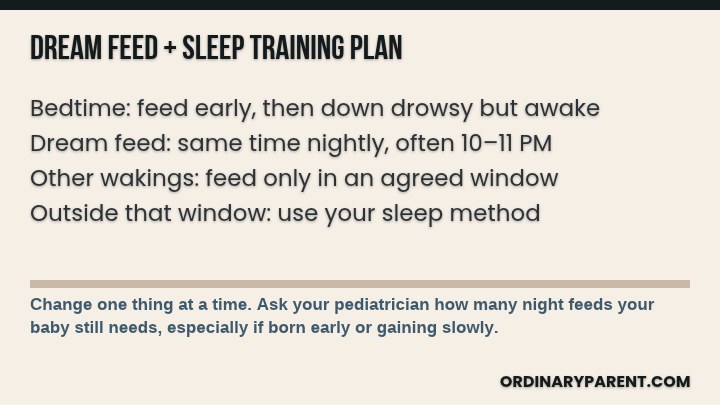
Start with bedtime, because that’s where most of the learning happens. Feed your baby early in the routine, before the bath or book, so milk isn’t the last thing they remember before sleep. Then put them down drowsy but awake and follow the method you’ve chosen.
Next, pick a fixed time for the dream feed. Most families land between 10 p.m. and 11 p.m., usually just before the parents go to bed. Keep it the same every night for at least the first two weeks. A predictable feed makes it easy to tell real hunger from habit later on.
During the dream feed, keep the lights low and the room quiet. Don’t chat or change the diaper unless it’s soaking or dirty. Burp gently, then lay your baby back on their back in the crib. If you want to know how much to offer, our guide on how much milk for a dream feed walks through it by age. New to the routine? Our step-by-step guide on how to dream feed without waking your baby covers the details.
Finally, agree on the plan with whoever else does nights. If one parent feeds at every cry and the other uses check-ins, your baby gets two rulebooks. A short note on the fridge helps more than you’d think.
The feed-or-soothe rule for other night wakings
This is where most plans wobble. Your baby has had the dream feed, and now they’re awake at 2 a.m. Do you feed them or follow your sleep training method?
A simple rule works for a lot of families. Decide ahead of time how many feeds your baby still needs after the dream feed. Your pediatrician can help with that number. A 4-month-old may still need one more feed before morning. Many older babies need none.
If the waking falls inside an allowed feeding window, feed them calmly and put them back down awake. If it doesn’t, respond with your method instead: a pat, a quiet “shh, it’s sleep time,” and timed check-ins. This keeps feeding tied to the clock and not to crying.
Keep an eye on the pattern for a week. If your baby wakes right after the dream feed every night, the feed may be stirring them too much. Our post on why a baby wakes up after a dream feed covers the usual fixes.
Should you drop the dream feed before sleep training?
You don’t have to, and dropping both at once can make for a rough week. If your baby is under about 6 months, most families keep the dream feed and train bedtime first. Changing one thing at a time makes it easier to see what’s working.
The dream feed may be ready to go once your baby falls asleep on their own and sleeps well after it. Look for a baby who barely drinks at the dream feed or fights it. Watch for one who eats less in the morning because of it, too. At that point, shrink the feed slowly, cutting about 30 ml (1 ounce) every few nights or a few minutes on the breast. Then stop it.
Some babies drop it with no fuss. Others wake at 4 a.m. for a week while their hunger shifts to daytime. Either is normal. For a full timeline, see when to stop dream feeding your baby. If you’re wondering about night feeds in general, when babies stop night feeds is a good next read.
When to talk to your pediatrician
Check with your baby’s doctor before you start any sleep training, especially if your baby was born early, has reflux or is gaining weight slowly. Those babies may need night feeds longer than the usual timelines suggest. The American Academy of Pediatrics has a helpful overview on getting your baby to sleep that’s worth reading together.
Call sooner if your baby has fewer wet diapers or seems hungry all day. Do the same if they cry in a way that sounds like pain, or if night wakings suddenly get worse alongside fever or ear tugging. Sleep training only works on a healthy, well-fed baby. And whatever you choose, keep the safe sleep basics: back to sleep, a firm flat mattress and nothing else in the crib.
Dream feed and sleep training FAQ
Will a dream feed undo sleep training?
Usually not. The dream feed happens on your schedule while your baby is drowsy, so it doesn’t reward waking. Problems show up when the feed fully wakes your baby or when other wakings also get milk.
What age can I sleep train and still dream feed?
Many pediatricians say sleep training can start around 4 to 6 months. The dream feed often continues for a few weeks or months after that. Ask your pediatrician what fits your baby’s weight and feeding.
Does the Ferber method work with a dream feed?
Yes. The Ferber method, or timed check-ins, handles how your baby falls asleep at bedtime and after wakings. The dream feed sits outside that process at a fixed time, so the two fit together.
Should I wake my baby fully for the dream feed during sleep training?
No. Keep the feed as quiet and drowsy as you can. A baby who wakes fully and then has to settle again may protest, which turns the dream feed into one more waking.
Mixing a dream feed and sleep training doesn’t need to be all or nothing. Keep bedtime for learning to settle, keep the late feed quiet and predictable, and adjust one piece at a time. If you’re still deciding whether a late feed is right for your baby, start with our complete guide to dream feeding.

Ordinary Parent is a parenting blog dedicated to sharing practical advice, real-life experiences, and helpful tips for modern moms and dads. The goal of this platform is to make everyday parenting easier by providing simple solutions, organization strategies, and honest insights into family life.