
Your partner walks in the door and your toddler runs to him with a huge grin. Twenty minutes later you say it’s time for a bath, and that same little hand smacks your arm. If you’ve typed “why does my toddler hit me but not daddy” into your phone late at night, you’re far from alone. Parent forums are full of this exact question. It stings, and it can feel personal. Most of the time it isn’t a sign that your child loves you less. It’s a sign of where they feel safe enough to fall apart.
Why does my toddler hit me but not daddy?
Hitting is common between about 18 months and 3 years. Toddlers feel big emotions long before they have the words or the brakes to handle them. Their hands are faster than their language. The American Academy of Pediatrics has practical tips for this kind of aggression, and most of them come down to calm, steady guidance.
The harder question is why the hitting lands on you. A few patterns explain most families, and usually more than one is going on. Look at who spends the most hours with your child. Ask who handles the hardest moments of the day, and how each of you reacts when a hand flies.
You’re the safe place for big feelings
Young children often save their worst moments for the person they trust most. With that person, they can let go without fear of losing them. Many parents notice the same thing at daycare pickup. Their child holds it together all day, then melts down the second they see mom.
If you’re the main caregiver, you get the tired, hungry, overwhelmed version of your child. Daddy might get the fun version who’s been waiting all day to see him. That isn’t fair, and you’re allowed to find it exhausting. But it does tell you something reassuring. Your toddler feels sure of you. To them, you’re a safe enough place to be messy.
You handle the hard parts of the day
Think about when the hitting happens. For most toddlers it clusters around transitions and limits. Leaving the park, getting dressed, turning off the TV, brushing teeth and going to bed are all classic flashpoints.
If you’re the parent who runs most of those moments, you’ll catch most of the frustration. It’s less about you as a person and more about your role. If daddy mostly does playtime, tickles and weekend outings, he rarely stands between your child and something they want.
A simple test helps. For a week, let daddy take over one or two of the hardest transitions, like bath time or the end of screen time. Many families find the hitting starts to spread out or drops overall. That tells you it was about the moment, not the person.
How each of you reacts to hitting
Toddlers are little scientists. They repeat whatever gets a strong, interesting reaction. If you gasp, explain, plead or get visibly upset, hitting can turn into a reliable way to get your full attention. Even attention that looks negative is still attention.
Some dads respond with a short, flat “No, I won’t let you hit” and simply move away. Others are just less available, which gives the behavior less to work with. Neither of you is the better parent here. It’s just that one reaction feeds the habit and the other starves it. If “my toddler hit me but not daddy” sums up your week, watch those few seconds after each hit first.
If your toddler laughs while they hit you, that’s often the same pattern with an extra layer. We go into that in detail in why your toddler hits you and laughs.
What to do when your toddler hits you
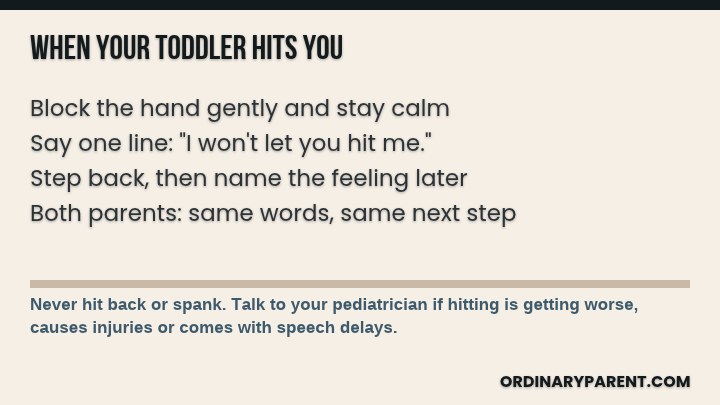
In the moment, your job is to stay safe and stay boring. Gently catch or block the hand. Say one short sentence in a calm voice, like “I won’t let you hit me.” Then step back or put a little space between you. Skip the lecture for now, because your toddler can’t take it in mid-meltdown.
Once things are calm, name the feeling and give them something else to do. “You were mad that bath time started. You can stomp your feet or squeeze this pillow.” Practice that swap during happy moments too, so it’s familiar when anger hits.
Don’t hit back or spank, even lightly to “show how it feels.” The AAP advises against spanking because it teaches that hitting is how big people solve problems. It’s also linked with more aggression over time. You can read their full advice on effective discipline.
Getting daddy on the same team
Consistency between parents matters more than any single script. Sit down together and agree on three things. Decide on the words you’ll both use, the step you’ll take when a hit happens, and what happens next, such as a short break or leaving the activity.
Ask daddy to back you up in the moment without taking over. “Mommy said no hitting. I’ll help you calm down” is far better than swooping in as the rescuer. That move can teach a toddler that mom is the problem and dad is the escape.
It also helps if daddy owns some limits on his own, like bedtime on certain nights. When both of you set rules and both of you play, your toddler stops sorting you into “fun parent” and “no parent.” If bedtime is the main battlefield, our guide on how to keep a toddler in bed has a routine you can both follow.
When a toddler who hits me but not daddy needs a closer look
Most toddler hitting fades as language grows, usually by age 3 or 4. Talk to your pediatrician if the hitting is frequent and getting worse after a few weeks of steady handling. Do the same if it causes real injuries or happens alongside a speech delay or a loss of skills they used to have.
It’s also worth a check if your child seems scared of one parent or caregiver, or if the hitting started after a big change like a new sibling, a move or a new daycare. Cleveland Clinic has a helpful overview of toddler hitting and when it needs more support. Your doctor can check for things like speech or hearing problems that add to the frustration.
And look after yourself. Being the person your child hits is draining. If you notice resentment building or you’re close to losing your temper, tag out and take a few minutes. Taking a break is part of good parenting. If the stress is piling up, our post on how to make parenting less stressful has a few realistic ideas.
Common questions about toddlers who hit mom
Does it mean my toddler prefers daddy?
Not usually. Toddlers often show their hardest feelings to the parent they feel safest with. Preferences also swing back and forth during the toddler years, sometimes week to week.
Should daddy discipline our toddler for hitting me?
He should back you up, but not take over. A calm, shared response from both parents works better than one parent stepping in as the enforcer.
At what age should a toddler stop hitting?
Most children hit less as their language improves, often by around 3 or 4. If hitting is still frequent after that, or it’s getting worse, mention it to your pediatrician.
Why does my toddler only hit me when daddy is home?
Some toddlers get overexcited or feel torn when both parents are around, and they compete for attention. A calm, predictable response from both of you usually settles it within a few weeks.
You’re not the “bad” parent because your toddler hits you and not daddy. You’re probably the most familiar one. Share the hard moments, keep your response short and calm, and give it a few weeks. If the hitting comes with giggles, read why your toddler hits you and laughs next. If your evenings are hard because of night wakings, why your toddler wakes up crying may help too.

Ordinary Parent is a parenting blog dedicated to sharing practical advice, real-life experiences, and helpful tips for modern moms and dads. The goal of this platform is to make everyday parenting easier by providing simple solutions, organization strategies, and honest insights into family life.