
It’s 2 a.m. and you’re standing over the crib again. For weeks your baby slept a nice long stretch after the 10:30 top-up, and now they’re up every hour or two. You start to wonder if the dream feed is the problem. If you’re weighing the dream feed during the 4 month sleep regression, you’re asking the right question, and the answer is calmer than the internet makes it sound.
This post covers what actually changes around four months, whether the late feed helps or gets in the way, and how to adjust it without starting a new war at bedtime. If you’re new to the idea, our complete guide to dream feeding covers the basics first.
What the 4 Month Sleep Regression Really Is
Somewhere between 3 and 5 months, your baby’s sleep starts to look more like yours. Newborns drop straight into deep sleep. Older babies move through lighter and deeper stages in cycles, and they surface briefly between them. The Sleep Foundation explains that this shift is a normal developmental step, not a sign that something is wrong.
Those brief wake-ups are the key. An adult rolls over and drifts off. A baby who fell asleep while feeding or rocking may wake up, notice things have changed, and call for help to get back down. So the night fills up with wake-ups that look like hunger but often aren’t.
Other things pile on at the same age. Many babies are learning to roll, they’re far more alert to noise and light, and some go through a growth spurt. It usually settles within a few weeks, though every baby moves at their own pace.
The 4-month regression is one of several bumpy patches. Our baby sleep by age guide explains what to expect at each stage.
Does the Dream Feed Cause the 4 Month Sleep Regression?
No. The dream feed doesn’t cause the regression, and dropping it rarely fixes it. The regression comes from a change in how your baby’s brain handles sleep. A feed at 10 or 11 p.m. can’t create that, and it can’t undo it either.
What the dream feed can do is shape the early part of the night. For some babies it still buys a longer first stretch. For others it starts to backfire. They wake up fully during the feed, then struggle to settle, and the next wake-up comes sooner. We look at that pattern in detail in baby wakes up after the dream feed.
A more useful question is whether the dream feed still does its job for your baby. A few nights of simple notes will tell you.
Signs the Dream Feed Is Still Helping
Keep the dream feed if your baby takes a good amount, stays drowsy, and goes back down easily. Look at the stretch that follows it. If your baby still sleeps three or four hours after the feed on most nights, it’s earning its place.
It also makes sense to keep it during a growth spurt. Hungry babies wake more, and a full feed late in the evening can cover part of that need. If you’re unsure how much to offer at this age, our post on how much milk for a dream feed gives rough amounts by age.
Finally, keep it if it works for you. Plenty of parents like the late feed because it lines up with their own bedtime. That counts.
Signs It’s Time to Change the Dream Feed
Some babies outgrow the dream feed right around this age. Watch for a baby who barely drinks at the 10:30 feed, then wakes hungry at 1 a.m. anyway. That tells you the feed isn’t filling the gap.
Another sign is a baby who wakes up fully and gets cross or chatty. If every dream feed turns into a 40-minute resettle, you’re trading sleep for sleep. A third sign is a later first wake-up on nights you skip it by accident.
If you see these patterns for a week or more, don’t stop it overnight. A gentle shift works better and keeps your baby’s daily intake steady.
How to Adjust the Dream Feed During the 4 Month Sleep Regression
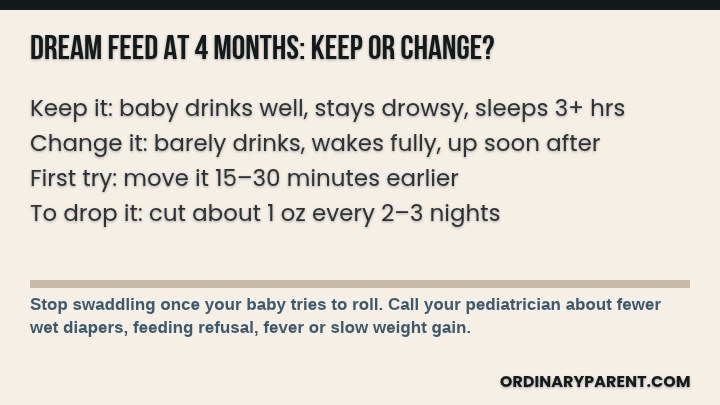
Start with timing. Try moving the feed 15 to 30 minutes earlier, so it lands in deeper sleep. Many babies are in their sleepiest stretch two to three hours after bedtime. Keep lights low and talk to a minimum.
If you decide to drop it, cut it down slowly. With a bottle, offer about 30 ml (1 oz) less every two or three nights. With breastfeeding, shorten the feed by a few minutes each time. When the feed is tiny, skip it and see how the night goes. Our post on when to stop dream feeding walks through this step by step.
Meanwhile, work on the wake-ups between cycles. Put your baby down drowsy but awake once a day, often at bedtime. Pause for a minute before you go in, since some babies fuss and resettle on their own. Keep night care boring, dim and quiet.
Don’t add a brand-new dream feed in the middle of the regression to “fix” it. Changing several things at once makes it hard to see what works.
Safe Sleep Changes Around Four Months
This age brings one safety change you can’t skip. Once your baby shows signs of trying to roll, it’s time to stop swaddling. The American Academy of Pediatrics advises this because a swaddled baby who rolls onto their tummy can’t push up. A wearable blanket or sleep sack with free arms is a common next step.
The usual rules still apply. Your baby sleeps on their back, on a firm flat surface, in a crib with no pillows, bumpers or loose blankets. After a dream feed, lay your baby down on their back, even if they’re already asleep. A short burp first helps some babies. See do you need to burp after a dream feed for that.
When to Call Your Pediatrician
Most regression nights are exhausting but normal. Still, call your baby’s doctor if your baby has fewer wet diapers than usual, refuses feeds, or isn’t gaining weight. Call too if you notice a fever, breathing trouble, vomiting, or a baby who seems unusually floppy or hard to wake.
It’s also worth a call if the night wake-ups come with ear pulling or crying that doesn’t ease when you pick them up. Sometimes a regression and an ear infection arrive together. And if you’re running on empty, say so. Your pediatrician cares about your sleep too, and they can help you plan.
Dream Feed and 4 Month Sleep Regression FAQ
Should I start a dream feed during the 4 month sleep regression?
It’s usually better to wait. Adding a new feed while sleep is shifting makes it hard to judge what helps. If your baby is hungry and gaining well, talk to your pediatrician before you add extra night feeds.
How long does the 4 month sleep regression last?
For many babies it lasts a few weeks. Some settle in two weeks, while others take longer. Steady routines and a little practice falling asleep often shorten it.
Can I drop the dream feed at 4 months?
Some babies are ready, especially if they eat well during the day and barely drink at the late feed. Wean it slowly over a week or two. Check with your doctor if weight gain has been slow.
Will the dream feed make night wakings worse?
It can if your baby wakes fully during it. Try moving it earlier and keeping it very quiet before you drop it.
Hang in there. This stage feels endless at 3 a.m., yet it’s a sign your baby’s brain is growing up. If you want the full picture of how night feeds wind down over the first year, read when do babies stop night feeds next.
This article is for general information and isn’t a substitute for advice from your child’s doctor.

Ordinary Parent is a parenting blog dedicated to sharing practical advice, real-life experiences, and helpful tips for modern moms and dads. The goal of this platform is to make everyday parenting easier by providing simple solutions, organization strategies, and honest insights into family life.