
You’re halfway through a bottle when you hear it: a little tick, tick, tick, like a tongue tapping against the roof of the mouth. Your baby keeps drinking, but the noise keeps coming back. If you’ve typed “why does my baby make clicking noises when drinking a bottle” into your phone at 3 a.m., you’re not alone. Baby clicking while bottle feeding is rarely dangerous. It’s a clue, though, and it’s worth knowing what it points to.
In most cases, that click is the sound of your baby’s seal on the nipple breaking for a moment. Their tongue slips, air rushes in, and they grab on again. Sometimes that’s a one-off. Sometimes it happens all feed long, and that’s when the cause matters.
What the clicking sound actually is
When a baby drinks well from a bottle, their lips flange out around the nipple and their tongue cups underneath it. That creates suction. The click happens when the tongue loses contact and the suction pops. You might also see milk dribbling from the corners of the mouth at the same time.
An occasional click while your baby settles in or gets drowsy is normal. Babies are still learning to coordinate sucking, swallowing and breathing. A clicking noise that happens with almost every suck is different. It usually means something is getting in the way of a good seal.
Why does my baby keep clicking while bottle feeding?
The most common reason is the nipple itself. If the flow is too fast, your baby may pull back or change their tongue position to slow the milk down. If the flow is too slow, they may suck harder and lose the seal. The shape of the nipple matters too. A very wide or very long one may not suit your baby’s mouth.
Position plays a part as well. A baby fed while lying almost flat can struggle to keep the nipple in the right spot. So can one whose bottle is tipped at an awkward angle. A stuffy nose can cause clicking too, because your baby has to break the seal to breathe.
Tiredness is another simple cause. A sleepy baby’s suck gets lazy, and the clicks often start near the end of a feed. If that’s the only time you hear it, you probably don’t need to change anything.
Could clicking be a sign of tongue-tie?
Sometimes, yes. Tongue-tie happens when the band of tissue under the tongue is short or tight, so the tongue can’t move freely. A baby with tongue-tie may struggle to keep a good seal on a breast or a bottle. The NHS lists a clicking sound while feeding among the signs.
Other clues tend to come with it. Feeds may take a long time, or your baby may seem hungry again soon after. Some babies have trouble lifting their tongue or sticking it out past their lips. Slow weight gain and lots of gas can also show up.
Only a health professional can diagnose tongue-tie. If several of these signs sound familiar, mention them to your pediatrician, health visitor or a lactation consultant. Many tongue-ties are mild and need no treatment at all.
Is baby clicking while bottle feeding causing gas?
Every time the seal breaks, your baby can gulp a little air. A few gulps don’t matter. Lots of them can lead to a tight tummy, more spit-up and a baby who squirms or cries after feeds.
If you notice that pattern, burping partway through the bottle can help. So can slowing the feed down. Our post on PURPLE crying vs. colic can also help you sort out what’s normal fussing and what might be something more.
Simple fixes for baby clicking while bottle feeding
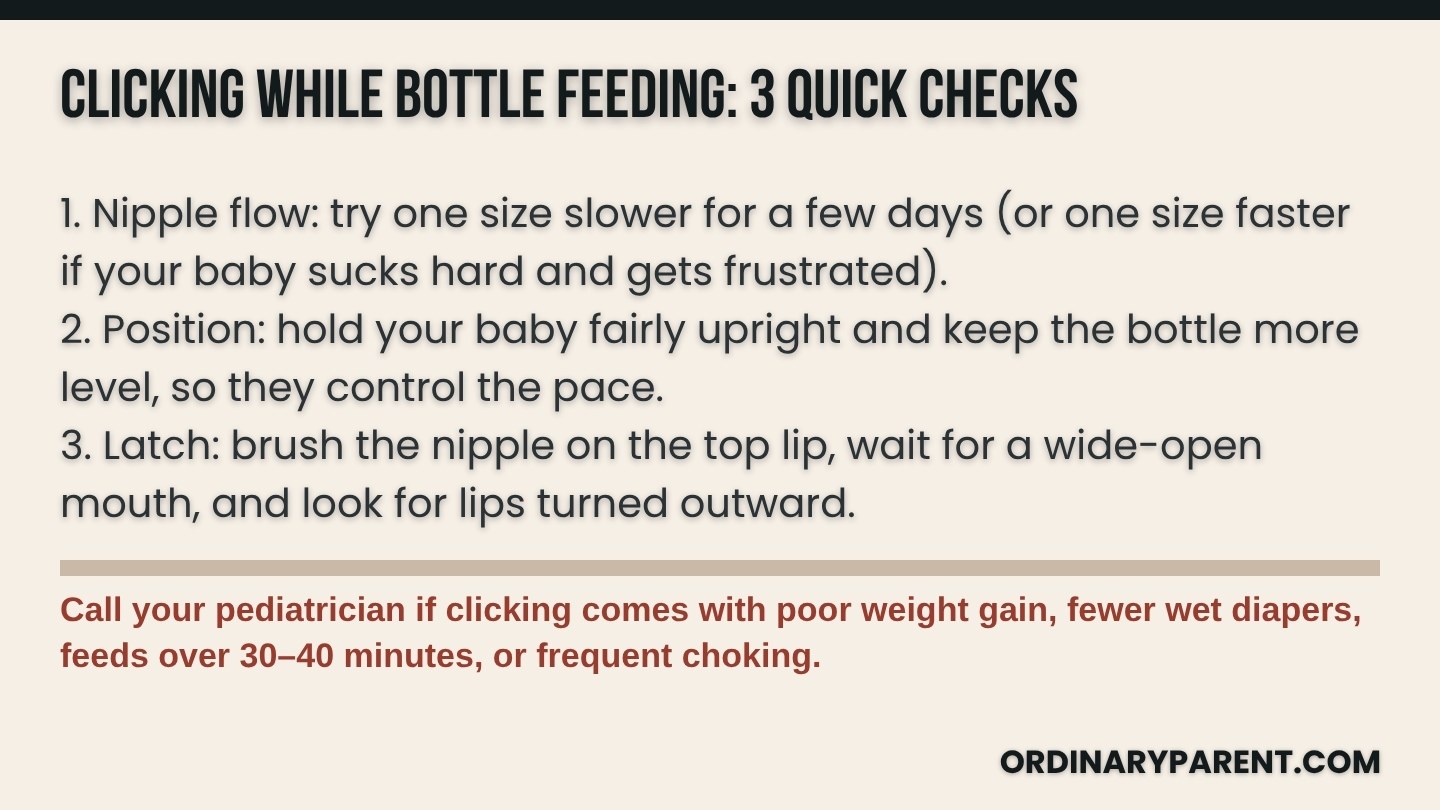
Start with the nipple. If you’ve moved up a flow size recently, go back down for a few days and listen. If your baby gets frustrated and sucks hard, try one size up instead. A different nipple shape is also worth a test, but change one thing at a time so you know what made the difference.
Next, look at how you hold your baby. Sit them fairly upright with their head and neck in a straight line. Hold the bottle more level, so the nipple is only partly full of milk. This style is often called paced bottle feeding. It lets your baby control the flow and take breaks.
Finally, check the latch. Gently brush the nipple against your baby’s top lip and wait for a wide-open mouth before you offer it. Their lips should turn outward, not tuck in. If your baby has a cold, a little saline and gentle suction before feeds may help them breathe. Ask your pediatrician which products are right for your baby’s age.
When to call your pediatrician
Clicking on its own isn’t an emergency. Call your baby’s doctor, though, if the clicking comes with poor weight gain or fewer wet diapers. Feeds that regularly take longer than about 30 to 40 minutes are another reason to call. The same goes for a baby who chokes, coughs or sputters often during feeds.
Get help right away if your baby turns blue around the lips, struggles to breathe or seems unusually floppy or sleepy. These signs need a prompt check whatever the cause.
Baby clicking while bottle feeding: quick answers
Is it normal for a newborn baby to be clicking while bottle feeding?
A little clicking is common in the early weeks while your baby learns to feed. If it’s constant, or your baby seems frustrated or gassy, it’s worth checking the nipple and their position.
Does clicking mean my baby isn’t getting enough milk?
Not always. Many babies who click still drink well. Watch their weight, wet diapers and mood after feeds for a better picture.
Can a baby outgrow the clicking?
Often, yes. As babies get stronger and more coordinated, many click less. If tongue-tie is the cause, though, it may not go away on its own.
Should I switch to a different bottle brand?
Try a different nipple size or shape first, since that’s usually the real issue. If that doesn’t help, a new bottle system is a reasonable next step.
Next time you notice your baby clicking while bottle feeding, listen for when it happens and try one small change. If you’re also working on night feeds, our guide on how to dream feed a baby walks through bottle positioning for sleepy feeds.

Ordinary Parent is a parenting blog dedicated to sharing practical advice, real-life experiences, and helpful tips for modern moms and dads. The goal of this platform is to make everyday parenting easier by providing simple solutions, organization strategies, and honest insights into family life.