
It’s 10:30 at night. You’ve warmed the bottle, lifted your sleeping baby out of the crib, and offered the feed. Nothing. Your baby turns their head away, clamps their mouth shut, or gives two lazy sucks and drifts off again. If your baby won’t take the dream feed, you’re probably wondering what you’re doing wrong. Or maybe the whole plan just doesn’t suit your child.
Usually the cause is fixable. It might be the timing, how deeply asleep your baby is, or how much they ate before bed. Sometimes they’ve simply outgrown the need. Each one has a simple check, and sometimes the right answer is to stop offering it.
Why Your Baby Won’t Take the Dream Feed
A dream feed only works if your baby sucks while mostly asleep. That depends on reflexes and sleep stage more than on hunger. Newborns root and suck almost automatically. Those early reflexes fade over the first few months. Older babies have to be a bit more awake to eat, so a feed that worked at 8 weeks can fail at 4 months.
Deep sleep is the other big factor. Babies cycle between light, active sleep and deep, quiet sleep. In deep sleep they go floppy, breathe slowly and evenly, and don’t respond much to touch. Offer milk then and you’ll often get no response at all. In lighter sleep you might see fluttering eyelids or small mouth movements. That’s when a sleepy baby is most likely to latch.
Then there’s the plain reason: your baby isn’t hungry. After a big bedtime feed, they may not want milk three hours later. That’s not a problem to fix. It’s information.
Check the Timing of the Dream Feed
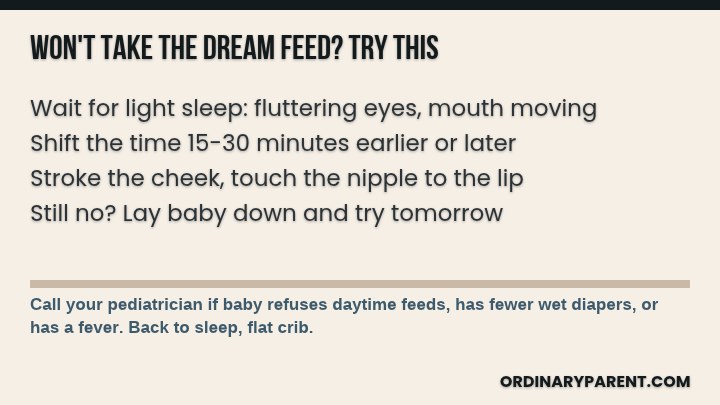
Most parents give the dream feed somewhere between 10 p.m. and midnight, about two to four hours after bedtime. Maybe you’re going in right as your baby hits their deepest sleep. Try shifting the feed 15 to 30 minutes earlier or later for a few nights.
Watch for those light-sleep signs before you pick your baby up. If your baby is completely limp and still, give it ten minutes and check again. Some parents find that changing the timing by half an hour is all it takes. Our dream feed schedule for newborns has sample times if you want a starting point.
Go in too late, close to your baby’s natural first waking, and they may wake up fully and fuss. A consistent time helps both of you settle into a pattern.
Help Your Baby Take the Dream Feed While Sleepy
You want your baby drowsy enough to stay asleep but alert enough to suck. A few small tricks help with that.
Stroke your baby’s cheek or the corner of their mouth to bring out the rooting response. Touch the nipple or bottle teat to their lower lip and wait a second rather than pushing it in. With a bottle, a drop of milk on the lips often gets things started. Some babies feed better when you hold them a little more upright or loosen the swaddle slightly.
Keep the room dark and quiet. Bright light, talking, or a diaper change can wake your baby enough that they protest instead of eating. If the diaper is only wet, it can usually wait until morning. Our step-by-step guide covers positioning for breast and bottle in more detail.
Give it about five to ten minutes. Still no luck after a couple of gentle attempts? Lay your baby back down and try again the next night. Forcing the issue rarely works and can leave you with a wide-awake baby at 11 p.m.
Breastfed vs. Bottle-Fed Babies
Breastfed babies sometimes struggle more with a sleepy latch because it takes more coordination than sucking from a bottle. Hand-expressing a little milk first so it flows right away can help. Side-lying feeding in your bed may feel easier. If you do it, move your baby back to their own safe sleep space before you doze off.
Bottle-fed babies may refuse if the flow is too slow and they have to work too hard while half asleep. A nipple that’s too fast can make them sputter and wake up. Does your baby take a bottle happily during the day but not at night? Try the same bottle and milk temperature they get in daytime feeds. The amount matters too: see our post on how much milk for a dream feed for typical ranges.
If Your Baby Won’t Take the Dream Feed, Is It Time to Stop?
Sometimes a baby who won’t take the dream feed is simply telling you they don’t need it anymore. This is more likely if your baby is past four to six months and eating and growing well. Another clue is that they sleep just as long on nights when they skip it.
Try a short experiment. Skip the dream feed for three or four nights and see what happens. If your baby still sleeps until their usual waking time, you can probably drop it. If they start waking hungry an hour or two later, the dream feed was doing its job. Give it another try with different timing. Our guide on when to stop the dream feed explains how to drop it gradually.
Keep in mind that the dream feed is optional. Plenty of babies never take one and sleep fine. It’s a tool for some families, not a requirement.
When to Call Your Pediatrician
One refused night feed in an otherwise healthy, well-fed baby isn’t a worry. Call your pediatrician if your baby refuses daytime feeds too, or has fewer wet diapers than usual. Get advice right away for a fever. In a baby under 3 months, 100.4°F or higher always needs a call. The same goes for vomiting, a baby who is hard to wake for any feed, or signs of dehydration like a dry mouth.
Also check in if your baby was born early or has had slow weight gain. The same applies if your doctor asked you to wake them for night feeds. In those cases, don’t drop night feeds without talking to your pediatrician first. The CDC’s page on signs your child is hungry or full is a helpful reference for reading feeding cues.
Whatever you try, lay your baby on their back on a firm, flat surface with nothing else in the crib. That’s what the American Academy of Pediatrics recommends.
Common Questions
Should I wake my baby fully if they won’t take the dream feed?
Usually not. Fully waking a baby for a feed they don’t want can unsettle the rest of the night. The exception is when your pediatrician has told you to wake your baby to feed. That’s common for newborns and babies with slow weight gain.
My baby takes only an ounce at the dream feed. Is it worth it?
Maybe. A small feed can still stretch sleep for some babies. Track a week of nights with and without it. If the small feed doesn’t change when your baby wakes, it probably isn’t worth getting up for.
Can I try the dream feed again after my baby refused it for a week?
Yes. Babies change quickly, especially around growth spurts and sleep regressions. If night wakings return, you can bring the dream feed back with a new time and see how it goes.
Is it normal for a baby to suddenly stop taking the dream feed at 4 months?
Very common. Fading newborn reflexes and changes in sleep cycles around this age make sleepy feeding harder. Our post on the dream feed and the 4 month sleep regression covers this stage.
Finding What Works for Your Baby
If your baby won’t take the dream feed, give it a few nights. Try a different time, look for light sleep, and keep things dim and calm. Some babies come around. Others are done with it, and that’s fine too. You know your baby’s rhythm better than any schedule does.
For the bigger picture, including how to start and how to phase it out, read our complete guide to dream feeding.

Ordinary Parent is a parenting blog dedicated to sharing practical advice, real-life experiences, and helpful tips for modern moms and dads. The goal of this platform is to make everyday parenting easier by providing simple solutions, organization strategies, and honest insights into family life.